
Most contract staffing problems do not start with poor hiring. They start with unclear accountability.
A bill rate looks competitive. Roles get filled quickly. Then attendance slips, supervisors get pulled into daily triage, and HR starts asking compliance questions that should have been resolved upfront.
Choosing a contract staffing agency determines how often those issues occur and how expensive they become when they do.
What Is a Contract Staffing Agency Responsible For
A contract staffing agency is responsible for more than payroll and recruiting.
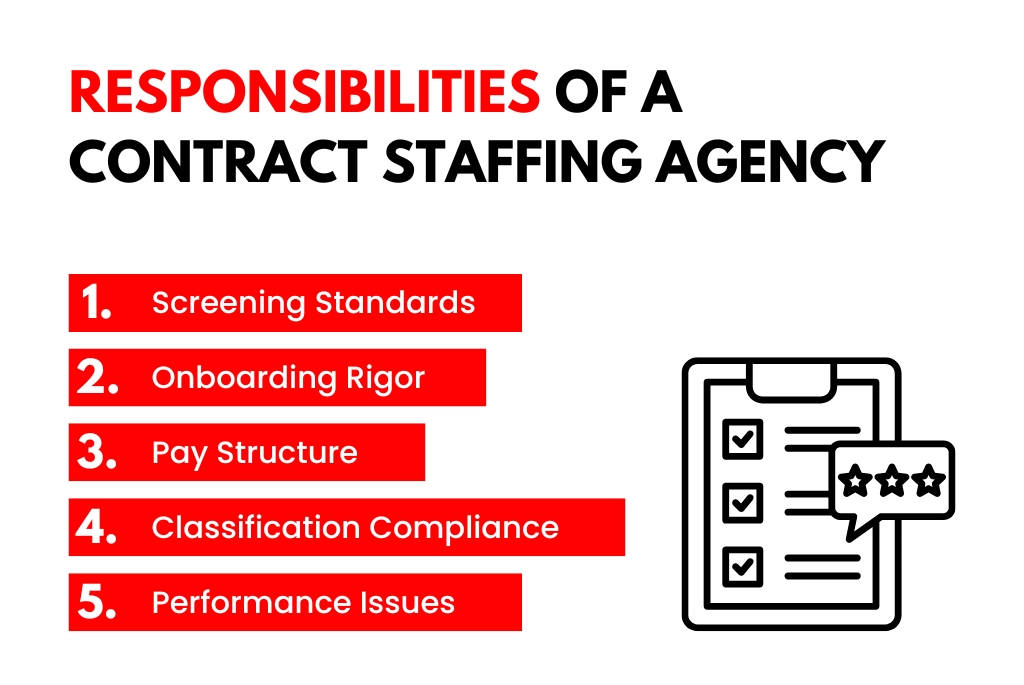
In practice, the agency controls screening standards, onboarding rigor, pay structure, classification compliance, and how performance issues are handled once workers are deployed. These decisions directly affect retention, safety exposure, and supervisor workload.
When those controls are weak, the client absorbs the downstream cost.
Why Choosing the Right Contract Staffing Agency Matters
Contract staffing agencies have shifted from “extra capacity” solutions to infrastructure builders. Many businesses now use contract labor to keep output steady through demand swings, cover hard-to-fill shifts, and staff for short-cycle projects without carrying permanent headcount that becomes a drag when priorities change.
What makes the agency choice consequential is the mix of operational pressure and exposure. Pay and availability move faster than internal compensation cycles. Compliance expectations around timekeeping, overtime, documentation, and supervision have tightened.
When the agency is sloppy, the client feels it immediately in supervisor time, training churn, safety risk, and payroll disputes. When the agency runs a disciplined process, contract labor becomes predictable enough to plan around. That predictability is the point.
The Fastest Way to Eliminate Weak Contract Staffing Agencies
Ask how the agency prices a single placement.
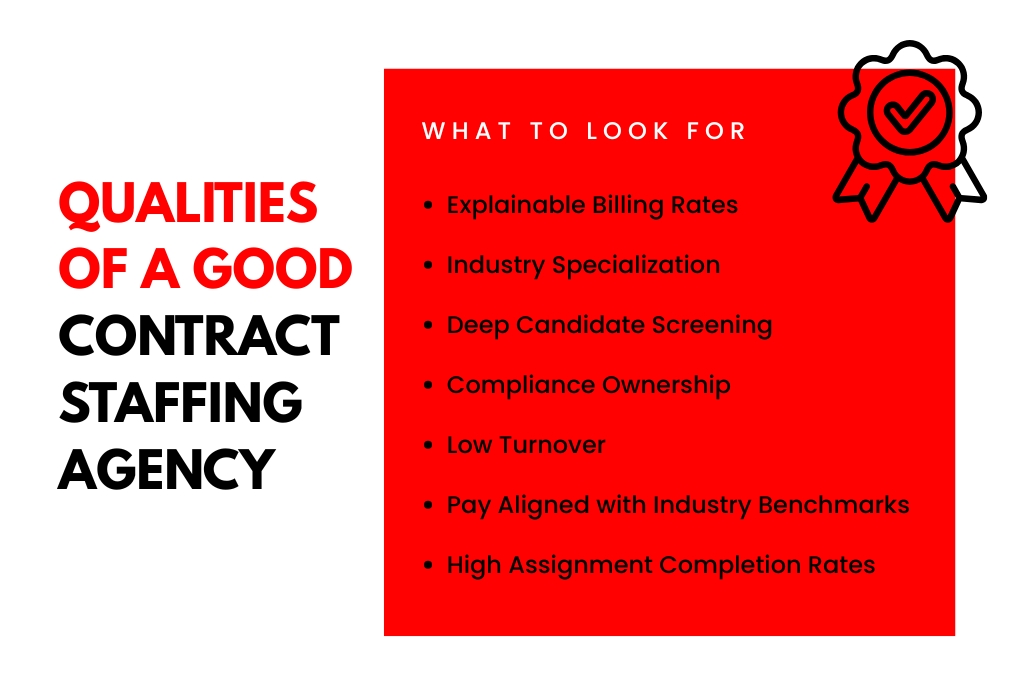
A credible contract staffing agency can explain bill rate construction clearly, including pay rate, statutory burden, insurance, and margin. Agencies that avoid this discussion often rely on volume and turnover to recover profitability.
That model shifts risk from the agency to the client.
Why Industry Specialization Matters in a Contract Staffing Agency
Agencies that staff the same roles repeatedly make fewer placement errors. Role specialization improves job scoping accuracy, screening relevance, and realistic productivity expectations. Generalist agencies often oversimplify roles, leading to faster starts and faster failures.
Ask how many active contractors the agency supports in similar roles and why assignments typically end early. Precision in the answer matters.
How Screening Quality Affects Retention and Safety
Screening depth predicts assignment success more reliably than resume volume. Attendance history, shift tolerance, and transportation reliability often matter more than marginal skill differences. Agencies that compress screening to improve fill speed increase early attrition and incident risk.
Contract Staffing Compliance Risks Hiring Managers Miss
Compliance failures usually surface late. Worker classification, overtime tracking, and ACA reporting require active oversight. When accountability inside the agency is unclear, problems emerge during audits or injury claims.
Ask who owns compliance decisions and how often processes are reviewed. Vague ownership signals reactive compliance.
How a Contract Staffing Agency Should Set Pay Rates
Pay rates must align with local labor markets, not just internal targets. The Bureau of Labor Statistics provides regional wage benchmarks that effective agencies monitor and revisit regularly.
Underpaying increases absenteeism. Overpaying without structure increases churn at assignment end. Agencies should explain how pay is set, reviewed, and adjusted mid-assignment.
How Technology Should Be Used by a Temporary Staffing Agency
Technology should surface risk, not just automate intake. Applicant tracking systems and digital onboarding improve speed, but they do not improve judgment. Strong agencies use technology to flag attendance trends, early performance issues, and compliance risks, then intervene manually. Automation without oversight increases scale, not stability.
Metrics That Matter More Than Fill Rate
Fill rate alone does not predict success.
More meaningful indicators include early attrition within 30 days, assignment completion rates, safety incidents per hours worked, and rehire ratios. According to American Staffing Association turnover data, when turnover rates fall, employee tenure rises, and firms spend less on recruiting, onboarding, and training replacements; this reduction in churn correlates with lower operating costs and better service outcomes for clients.
Agencies that track these metrics tend to manage placements more deliberately.
Two Contract Staffing Signals Most Buyers Overlook
First, how do assignments end? Structured offboarding improves redeployment quality and reduces operational disruption. Poor exits often mirror poor starts.
Second, how is underperformance addressed? Agencies that replace workers without diagnosing root causes tend to repeat the same failures.
These signals rarely appear in proposals. They appear in process descriptions.
How PeopleSolutions Structures Contract Staffing Differently
PeopleSolutions operates with a narrower definition of success than most contract staffing agencies.
The model emphasizes role clarity, screening depth, and market-aligned pay strategy. Performance tracking prioritizes assignment completion and retention rather than raw fill volume. This structure reduces surprises rather than promising their absence.
Final Takeaway for Hiring Managers and HR Teams
Choosing a contract staffing agency determines how predictable labor becomes after the contract is signed.
The strongest agencies do not promise fewer issues. They reduce how often issues escalate and how costly they become when they do.
Hiring teams that ask sharper questions early tend to see quieter operations later.